

If your thrift store has more books than it can keep on the shelves, start by separating the stock you want to sell from the books you want to move on. Then ask a collection partner about the quantity, frequency and handoff your store actually needs. A one-time load of old stock and a steady flow of surplus donations need different arrangements.
You do not need a title-by-title inventory to start that conversation. A rough box count, a few photographs and an explanation of where the books come from are more useful than a message that simply says “lots of books.”
Decide which books are ready to leave
Give staff a clear rule for moving books off the sales floor. Your store might use a dated shelf rotation, the end of a sale or a decision by the person who manages the book section. Choose a rule that fits your shop; there is no single shelf life that makes every unsold book surplus.
Keep those books apart from donations that still need sorting. Otherwise, a collection can accidentally include stock you intended to price, while the same unsold books return to the shelves.
Set aside anything that needs a separate decision, such as a donated collection someone has asked you to assess. Do not assume that a bulk collection offer includes individual valuations.
Measure the backlog and the weekly flow separately
“Thirty boxes ready now” tells a collector about the first visit. “Another six boxes most weeks” tells them whether a recurring arrangement might fit. Include both numbers, even if they are estimates.
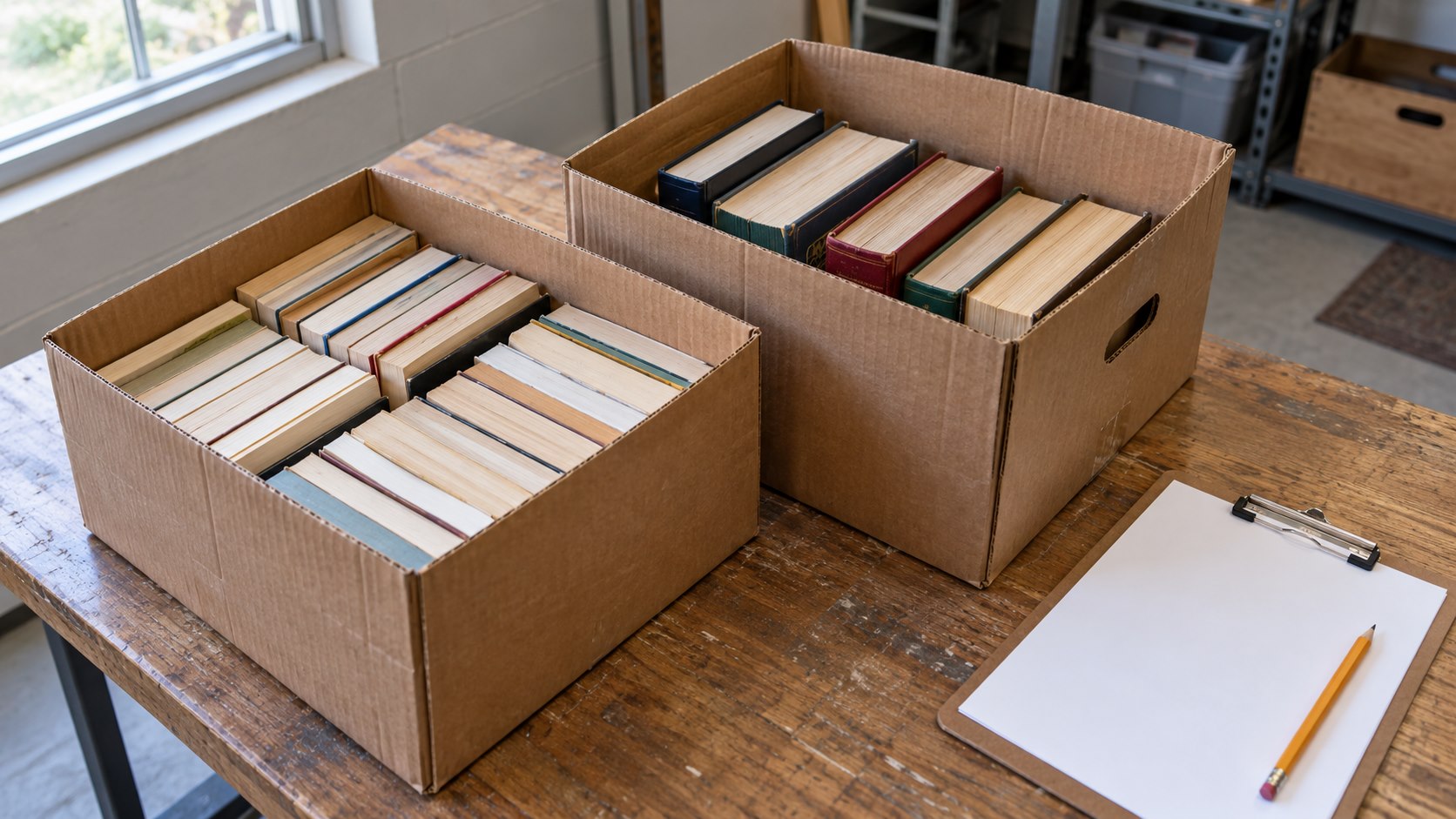
Use a unit your team can repeat: the same size of box, a particular tote or a measured weight if you already have a suitable scale. A box count is hard to interpret when some boxes hold a few paperbacks and others contain oversized hardcovers. Photographs can help explain the difference.
A simple note can cover:
- The books waiting now, with an approximate quantity and container size.
- How much more usually accumulates between collections.
- Unusual peaks, such as a donation drive or another branch sending its surplus.
- The space available for books awaiting pickup.
If several stores use one collection centre, say so at the beginning. Give the address where the books will actually be ready, and distinguish that site's combined volume from the amount at each branch.
Ask what the collection arrangement includes
Before accepting an offer, establish which books it covers, how the handoff works and whether any payment applies. Collection and purchasing are separate questions. A partner who can remove surplus books is not necessarily offering to buy every load.
At Sustainable Books, we can discuss collection and purchasing options suited to your store. The arrangement depends on the books, quantities, location and collection needs. Our guide to how Sustainable Books works explains our broader book reuse process; use the contact form to discuss your organization's particular load.
Ask about containers before buying supplies. For recurring partners in Ontario, Sustainable Books supplies reusable totes and exchanges full totes for empty ones. A first collection can be boxed, and partners can use their own boxes for overflow. Confirm the container arrangement and availability for your store rather than assuming a particular number of totes will arrive.
For any proposed partnership, get answers to these questions:
- Which book types and conditions does this arrangement cover?
- Is this a one-time collection or a recurring route stop?
- Who supplies containers, and what happens when they are full?
- Are the books being supplied without payment, or is purchasing being discussed?
- Who should the store contact when the expected quantity changes?
Make the first handoff easy to understand
Describe the route from the books to the collection vehicle. Mention a loading door, stairs, an elevator, parking restrictions or a receiving area shared with other businesses. Include receiving hours and the name of the person who can show the driver which books are leaving.
Photograph the whole collection and its access point if that helps explain the space. Avoid including customer records or people who have not agreed to appear.
For books going into boxes, our book-packing guide covers manageable containers and keeping a collection together. Confirm handling requirements with the collector before preparing a large load. Do not assume a vehicle can take every box simply because a visit is scheduled.
Agree on an overflow plan
A recurring collection needs a plan for the week when donations arrive faster than expected. Decide who will flag the extra volume and how early they should get in touch. Ask what happens if a collection is delayed or the available vehicle space is smaller than the load.
For example, a store could record the number of full totes after each visit and contact its partner when the remaining space will not cover the next expected deliveries. That is a planning example, not a promised collection timetable.
Review the arrangement after the first few visits. Were the volume estimates close? Were enough empty containers available? Could staff identify the outgoing books without calling a manager? Those answers give you something concrete to adjust.
Tell us about your store's surplus books
For a first enquiry, send your store or collection centre's location, the quantity ready now, the amount you expect regularly and any access details. Include a deadline if you are clearing a room, closing a location or managing a backlog.
Contact Sustainable Books about an organizational book collection. We can discuss the load and confirm whether a suitable arrangement is available. Collection timing and coverage depend on location, routes and capacity; a recurring schedule or purchasing offer needs to be agreed for your store.